Sunday, September 30, 2012

"The die is cast, so to speak, for developing diabetes, metabolic syndrome, and hypertension."


Researchers retrospectively analyzed rates of teenage obesity among nearly 1,500 morbidly obese adults seeking bariatric surgery, looking for relationships between teenage body weight and health conditions during adulthood.

A patient's body weight at age 18 was a key predictor of diseases in adulthood, including renal disease, walking limitations and diabetes, TheHeart.org reported.


Obese teenagers who undergo bariatric weight-loss surgery may see the benefits well into adulthood and waiting until after age 18 may put patients "past the point of no return," researchers say.
 Obese teenagers who undergo bariatric weight-loss surgery may have a better chance later in life of staving off diabetes, hypertension, asthma and other health issues than if they remain obese into adulthood, according to a new study.

"When we looked at children in the Princeton School District cohort," researcher Dr. Thomas Inge dissected the data for those with a BMI over 40, looking at them over 5 years, they continued to gain weight, and they gained at a rate of 1 BMI point a year thereafter."
"The critical point is that, after 18, you may be past the point of no return," Inge added. "The die is cast, so to speak, for developing diabetes, metabolic syndrome, and hypertension."

Investors Rushing as Obesity Treatment Devices Have Big Potential in Medical Marketplace


Approximately one-third of U.S. adults are obese, according to the Centers for Disease Control and Prevention (CDC). And while this weighty statistic does not bode well for the health of Americans, it does represent a wealth of opportunity for medical device manufacturers.

Among the few weight-loss devices that can boast brand recognition, thanks to a ubiquitous advertising campaign, is the Lap-Band adjustable gastric banding system. However, this pervasive marketing campaign was the subject of a stern warning from FDA  last month that accused several surgical centers and a marketing firm of downplaying the device's dangers, contraindications, and side effects.
Although the laparoscopically placed Lap-Band has proven successful in the market—despite the recent marketing brouhaha—various medical device manufacturers are forging a different product design path for next-generation devices by offering a nonsurgical, nondrug obesity treatment.  
ReShape Duo ProductReShape Medical (San Clemente, CA), for example, has developed what it claims on its Web site is the "first and only nonsurgical, dual-balloon treatment for the millions who want a fast track to weight loss, without the risks of surgery or side effects of drugs." Designed to take place in a 30-minute outpatient procedure, placement of the ReShape Duo entails the insertion of an endoscope through the mouth and into the stomach. Then, the uninflated balloons are positioned in the stomach via a guidewire, after which the balloons are inflated with saline.

Orange County, Ca is becoming a hub for medical devices in Obesity, Ophthalmology, Cardiovascular and other therapeutic areas.
Onciomed, Inc based in Irvine, CA is working on a minimally invasive laproscopic procedure, which is reversible and  can reduce the dependance of anti diabetic medicaltion the procedure takes about 45 min. The company is working on its Series A funding. The company claims it has reached mile stones that other competitors have reached at Series B funding. This could be a great advantage for investors. The product has great potential said on of the ASMBS international faculty surgeons. Product is under clinical evaluation outside USA.
Soon there will be many "Obesity Clinics" around . Just like opthalmologist, are now called "Lasik Surgeons"
bariatric surgeons will be called  "Obesity Surgeons"

Friday, August 31, 2012

Little change in U.S. obesity rates in recent years


Little change in U.S. obesity rates in recent years 2009-2010


Subway riders walk through the turnstiles while leaving the U.S. Open in New York in this September 4, 2007 file photo. REUTERS/Lucas Jackson/Files
NEW YORK | Tue Jan 17, 2012 12:23pm EST
(Reuters Health) - The number of kids and adults in the United States who are obese has held steady over the last few years, two reports out Tuesday suggest.
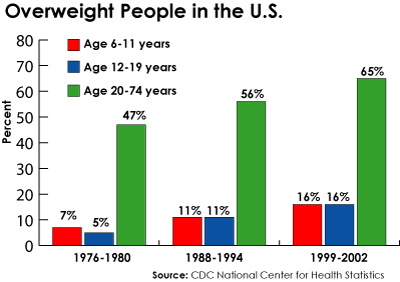
Government researchers found that in 2009 and 2010, about one in three adults and one in six kids and teens were obese. The rates represent no change from 2007 and 2008 figures, and only a slight increase among specific demographics over rates from the late 1990s and early 2000s.
"I'm not very surprised, but I think this is a kind of encouraging finding, given all the efforts we have been making," said Dr. Youfa Wang, head of the Johns Hopkins Global Center for Childhood Obesity in Baltimore, who was not involved in the new study.
"The general public for sure nowadays has become more aware of the health consequences of obesity, and industry has been heavily influenced by all the efforts," Wang told Reuters Health.
With rates of overweight and obesity in the U.S. increasing throughout the 1980s and 1990s, some researchers projected those trends would continue into the next century and that type 2 diabetes and heart disease risks would rise with them.
The most recent obesity data come from two nationally-representative studies of about 6,000 adults and 4,000 kids and teens who had their heights and weights measured in a mobile exam center in 2009 and 2010.
From that data, researchers calculated each person's body mass index, or BMI -- a ratio of weight to height. A BMI of 30 or over -- equal to a five-foot, six-inch adult weighing 186 pounds or a kid in the 95th percentile or higher on growth charts -- is considered obese.
Cynthia Ogden from the Centers for Disease Control and Prevention and her colleagues found that between 35 and 36 percent of both men and women were obese. While obesity rates in men were similar across races, that wasn't the case in women: 32 percent of white women were obese, compared to almost 59 percent of black women.
Compared to data from 1999 to 2000, the numbers represented a less than one percent annual increase in the rate of obesity in men overall, and no net increase in women. The exceptions were black and Mexican American women, who also had slightly higher obesity rates in 2009 and 2010 than a decade earlier.
Ogden said that the long-term results suggest rates of obesity in men have slowly caught up to rates in women.
But, she added, there was no change in obesity rates in any demographic compared to the most recent prior data, from 2007 to 2008.
Seventeen percent of kids and teens were obese, a rate that varied from 14 percent in white kids to almost a quarter of black kids. Overall rates were similar to those reported in 1999 and 2000 for girls, with a slight uptick in obesity among teen boys since then, Ogden and her colleagues reported in the Journal of the American Medical Association.
"I think that you can be fairly comfortable in saying that even if there is an increase, it's small relative to the increases in the 1980s and 1990s," Ogden said.
She told Reuters Health that there's also evidence that obesity rates are leveling off in some countries in Europe and elsewhere in the world.
RATES 'STILL QUITE HIGH'
Amika Singh, who has studied childhood obesity at VU University Medical Center in Amsterdam, said it's too early to draw conclusions on a more global scale.
"The basic thing is that, even if things are leveling off, these are still quite high numbers," Singh, who was not involved in the new research, told Reuters Health.
Ogden said it's difficult to point to one reason why the rate of obesity in the U.S. has seemed to stabilize, while some projections figured it would continue to rise.
"It was hard to know exactly why (the increase) was happening in the first place, because obesity is very complex and there are so many factors that contribute to it," she said.
Wang pointed toward efforts made by First Lady Michelle Obama to combat childhood obesity, as well as more funding going to research on obesity and how to prevent it.
"The impact is dramatic," he said. "I think this obesity data shows that a combination of many efforts can make some difference."
SOURCE: bit.ly/hwxtTL Journal of the American Medical Association, online January 17, 2012.

The Obama government has done nothing to promote companies or fund companies working in new innovations in obesity. The govt should fund these projects.

Sunday, July 8, 2012

Investing in Good Karma - Investing in Obesity Treatment Companies

Feel good about doing good. Your cause, your way. We believe that investing in a healthier planet leads to healthier communities...
US spends $150 Billion on obesity and obesity related problems. Companies working on innovation in obesity treatment need investment. Philanthropist organizations and families have the  to invest in the obesity technology companies, opportunity to invest in obesity related technologies and feel good about doing good.
One such company is Onciomed, Inc.
Onciomed, name is derived from the unit of weight Ounce.
 info@onciomed.com


Monday, May 7, 2012

Health Care Bubble & Cost of Obesity: Why invest in Health Care Technologies?

Dot com bubble. Real estate bubble. Commodities bubble. Healthcare bubble? How can the US healthcare system be a bubble when tens of millions are uninsured and more people fall through the cracks daily? The media, public, and politicians alike have been more concerned with the inadequacies of the system than with its rapid growth. US healthcare spending has grown enormously, exceeding the rate of inflation for decades to become the largest sector of the US economy. The United States now spends over 16% of its GDP on healthcare, almost double the average for developed nations.

Perhaps Americans just demand the best and priciest healthcare, with the most modern technology and treatments. If Americans paid for healthcare themselves, this would simply represent a rational spending choice. But the federal government now incurs 60% of all healthcare spending, meaning that taxpayers, and not individuals, pay for most of our healthcare. Medicare, Medicaid, and other direct government healthcare accounts for 46% of healthcare spending, while tax breaks on healthcare subsidize another 10-15% of healthcare spending [1].
At current growth rates, government healthcare spending will exceed the entire Federal budget by 2050 [2]. Total spending on healthcare will near one-third of GDP by 2030. It’s unlikely that the US can devote 1/3rd of all productive capacity to healthcare without crippling other sectors of the economy and reducing overall economic growth. The healthcare bubble thus dwarfs all previous bubbles in size, since the technology, real estate, and energy sectors are all so much smaller.
How will the bubble pop, and what will its effects be? Since most healthcare spending is federal, the bubble will pop when the government can no longer afford its healthcare outlays. The US has been able to borrow freely by issuing debt for many decades, but this will eventually end once our debt exceeds GDP. With the current downturn, government debt may actually exceed GDP by 2015 [3]. Thus the reckoning may come sooner than many expect.
Will healthcare reform contain costs and deflate the bubble gradually? Most reform plans focus more on increased coverage than on cost control, so they may exacerbate the problem. Eventually the hard choices will have to be made, and they will include some combination of reducing Medicare benefits, cutting provider reimbursements, openly rationing government health care, and limiting the tax break on health insurance. I just hope that some of the hard choices are made before we are collectively up against a fiscal wall.
[1] $200 Billion in taxes are foregone as a result of the employer-based healthcare tax deduction, equivalent to 10% of all healthcare spending. When this subsidy is included the government’s share of healthcare spending rises to 56%. This analysis does not include the exemptions on property taxes and sales taxes that healthcare providers receive; adding these subsidies in would likely drive the government’s share of health care spending over 60%.
[2] The CBO predicts that Medicare and Medicaid will account for 14% of GDP by 2050. This figure doesn’t include healthcare spending through the VA system, SCHIP program, and other federal healthcare programs, which total $100 Billion in spending today. If these programs also grow commensurately, total government spending may near 18% of GDP in 2050, roughly equivalent to total government revenue.

[3] This projection of public debt growth shows that US government debt will exceed gdp by 2050. This only takes into account debt held by the public, however. Gross government debt is already above 65% of GDP, and may grow to 75% by the end of 2010 as a result of the recession and stimulus spending. With deficits of $500B+ per year possible for several year, US total government debt could exceed gdp in less than 10 years.
Friday, February 24, 2012

China Predicted to Have Childhood Obesity Problem

Childhood obesity is ballooning into a big problem in China as 'little emperors' are increasingly getting an appetite for the Western couch-potato way of life, according to a study presented in Geneva.
Almost one in five children under seven is overweight and more than seven percent are obese, according to a study of the Chinese National Task Force on Childhood Obesity, presented at the sidelines of the annual meeting of the World Health Organization.

Chinese experts looked at 80,000 children from 11 major cities, and found an increase of 156 percent in the numbers of obese children between 1996 and 2006. Meanwhile, the number of overweight children grew 52 %.

"When a poor person gets richer, the first thing he does is to get better food. That's a big driver of obesity,"

With large swathes of population in the country still poor and many increasingly getting richer, the problem would not reach its full-blown extent until the years to come.

The adoption of Western couch-potato style of life in the cities is the problem, as parents feed their children with fat and sweet food, according to the scientist.
Children are not only consuming sodas and ice cream, but also not doing enough exercise to work off the calories.

 China “has entered the era of obesity,” according to Ji Chengye, a leading child-health researcher, who says that “the speed of growth is shocking.”
[ USA Today “Obesity of China's kids stuns officials” Jan. 9. 2007 ]


Urban Chinese boys age 6 are 2.5 inches taller and 6.6 pounds heavier on average than Chinese city boys 30 years ago, according to China’s Health Ministry. The Education Ministry reports that 8% of 10- to 12-year-olds in China’s cities are obese, with an additional 15% classified as overweight.
[ USA Today “Obesity of China's kids stuns officials” Jan. 9. 2007 ]
 

About 8.1% of Chinese children in urban areas are obese, compared to 3.1% in rural areas.
[ National Geographic News “Obesity Explosion May Weigh on China's Future” August 8, 2006 ]


China’s obesity rate is exploding—about 30 to 50 percent annually
(or six million to 10 million more obese every year).
[ PBS Newshour “For China's Growing Middle Class, Expanding Waistlines Pose Problem” June 1, 2010 ]

About one in 10 adults in China have diabetes
(representing about 90 million diabetics).
[ BBC News “China faces obesity explosion” Sept. 25, 2010 ]
China’s “obesity explosion” has resulted in growth of Chinese fat camps
, which costs about a thousand U.S. dollars (U.S.) per child.
[ National Geographic News “Obesity Explosion May Weigh on China's Future” August 8, 2006 ]

 
Parents and school systems place academic results above sporting achievements. This is indicated in the little emphasis on sports, which takes up less than two hours of the school week.

The one-child policy which has been implemented in the last 30 years further complicates the issue in a country which considers being fat as a sign of good health and prosperity.

A healthy baby, for example, is in the Chinese language described as a "fat baby".
"The one-child policy led parents to overprotect their children. The behavior of grandparents are of special concern they tend to overfeed their grandchildren because they think that being fat is a sign of the family's wealth," one professor said. The traditional preference for boys is also reflected in the statistics, which show that 22 percent of boys and 17 percent of girls are overweight.
The professor sees about 20 young patients daily at the hospital where he practices in Beijing, but he refuses to impose a diet on them. The problem is doctors were never trained in medical school to deal with obesity, this was not a disease it was condition. Now, it has become a disease.
It has also become the most expensive and the biggest killer because it can cause other problems.
Like US. China will also spend in Billions to treat obesity. US spends close to US$147 B in treating obesity and its related problems. By the end of the decade Obesity and Diabetes will be the biggest market for medical devices. 

Private investors, VCs and companies  are investing heavily in US based new technologies, mainly located in Boston or Irvine, California that can help cure obesity using medical devices or help reduce the incidence. Sobering thought is, if diet and exercise is started today, it will take 30 years to return to the normal levels. Let's solve the problem, at the grass root level, which is curbing complex food manufacturing, cheap foods and complex carbs are easily available which means  obesity and diabetes is inevitable!
Reorganize the food chart and add proteins, veggies and less carbs to the food chart and add exercise to it!!


Thursday, February 23, 2012

Obesity and Related Disease Market to Reach $500B by 2015

Private investor are jumping in to invest in Medical Device industry as it heats up for a health care boom in Asia by 2015. 
The increasing incidence of chronic diseases such as Obesity,  diabetes, cardiovascular disease, chronic wounds, immobility, pulmonary and vascular diseases is enhancing the need for patient care in hospitals, homes and other care facilities, thereby contributing to the demand for medical devices and diagnostics that are capable of enhancing the overall quality of life. The US leads the high-technology medical devices market, but faces fierce competition from emerging economies. Despite being way behind the US in terms of expertise or innovation, these countries compete on basis of production of low cost medical devices. Demand for medical devices in developing countries, especially China and India, is expected to grow at a faster rate than developed countries owing to factors such as rising disposable incomes, increase in patient population, growing waist lines, obesity on the rise and both India and China face an epidemic of diabetes and obeisty. Australia UK , US, Canada and Mexico are already declared an Obesity epidemic.
The obesity device market will be the biggest in the healthcare sector.
Asia is seeing increasing healthcare awareness, improvements in healthcare infrastructure and increase in healthcare spending . In majority of the Asian, Latin America and the Middle East countries, government efforts are focused on improving healthcare services and infrastructure facilities, which is expected to fuel the demand for medical equipment in the next 3 years.
India and china face a problem of metabolic disease. Which is a mix of hypertention, heart disease and diabetes. The smokers in the region have increased the incidence of tobacco related problems.
Coronary stent shown below is one medical device that is implanted every 20 seconds in Asia. 
There is a increased demand in consumables in the medical device sector. Implantables like the lap band will grow in Asia.
Technologies in orthopedics and spine are in great demand. Larger companies cannot compete with small and nimble manufacturers.
Spine surgery is reverting to posterior open repairs due to slower adoption of minimally invasive surgery. The outcomes show little difference between the traditional posterior fixation and minimally invasive surgery. It will take a decade for new technologies to be adopted.
Increase number of private investors are jumping into the space because the institutional investors have not raised new money to invest in early stage technologies.
 Private investors did not have this opportunity until recently.
Private and angel investors understand its a high risk high gain opportunity, accredited investors can take advantage and invest in companies in the seed stage and series A. After Series A  the institutional investors and venture capitalist jump in. Many of the private investors have potential to gain if the company exits in 4-5 years, which can be by virtue of M&A or IPO.