Friday, November 16, 2012

Shanghai is acting to head off an "obesity epidemic" as health authorities warn of a rising tide of diabetes and weight-related diseases.

Shanghai (China Daily/ANN) - Shanghai is acting to head off an "obesity epidemic" as health authorities warn of a rising tide of diabetes and weight-related diseases.
Roughly 40 per cent of adults in Shanghai are overweight or obese, and one-fourth of residents do not exercise enough, according to a report by the Shanghai Municipal Health Bureau, released on Monday.
The rise in obesity is being considered as an investment opportunity in treatments. Most of the innovation is happening in the US. Companies in SoCal like Allergan, Onciomed, Reshape are working on innovations in the obesity space. Onciomed, Inc recently announced its vital patent in treating obesity and diabetes.


"The rise in obesity among children and adults is very disturbing," said Li Guangyao, deputy director of the Shanghai Health Promotion Committee. "It will lead to many health problems and should be given attention."
In a recent academic paper, sports scientist Colin Boreham found that over the past 20 years, the number of obese Chinese men has grown from 3 per cent to 11 per cent, while the number of obese women has increased from 5 per cent to 10 per cent.
Abdominal obesity problems are particularly prominent, wrote Boreham, director of University College Dublin's Institute for Sport and Health.
The ratio of men with abdominal obesity, meaning with a waist circumference of 90 cm or more, increased from 8 per cent to 28 per cent, while women with abdominal obesity, a waist circumference of 80 cm or more, increased from 28 per cent to 46 per cent.
The findings of another survey, released at the end of 2011 by Shanghai health authorities, showed that the average weight of male residents has increased by 2.9 kg when compared with 2000. Over that same period, the average waistline of men has increased 2.3 cm.
"More health campaigns and public education activities are urgently needed to help residents better understand the harm being overweight or obese can do, and prompt them to keep moving and take measures on weight control," said Chen Wenhe, a professor at Shanghai University of Sport.
Like many people, Zhao Bin, a 25-year-old IT worker, spends a lot of his time either sitting in an office or curled up on the sofa at home.
"I know I'm putting on weight, but I barely have any energy to move after a whole day working," he said. "I just want to throw myself into bed after dinner."
Zhao weighs 90 kg, and is among a large group of people who are not inclined toward physical activities.
A citywide survey conducted this year by the Shanghai Health Promotion Committee, which surveyed about 8,600 residents aged 18 or over, found that adults spend a lot of time on sedentary pursuits.
An adult spends an average of 3.9 hours a day sitting without any significant physical movement, the poll discovered. Compared with a year earlier, nearly 70 per cent of residents also said they had reduced the time spent on daily physical exercises.
The city is encouraging residents to live healthier lifestyles and take positive steps to control their weight.
In addition to activities in communities, the committee also organises a contest to encourage residents to shed weight. Residents who successfully lose 3 kg can win prizes worth up to 2,000 yuan (US$321).
"Various campaigns and activities are aimed at helping residents have a healthier lifestyle, which can effectively reduce the chances of suffering various chronic diseases," said Li from the committee.

Sunday, November 4, 2012

Obesity: The Next Investment Driver

As the U.S. gets fatter, so might your wallet..

Investors worldwide are looking at Obesity as one of the maga investment drivers. Obesity cost US $147 Billion. 

Obesity once considered as a medical condition, in the last decade has become one of the biggest health problem facing all the developed countries. Countries like India, China, Brazil are seeing unprecedented obesity rates. Urban India has seen an 14% obesity in tier 1 and 2 cities. China has seen a 40% obesity rate in children, the primary reason is the new found wealth and one child policy which has translated into over pampered kids. 

Individual investors are looking at US to invest in obesity and related technologies. Early stage companies are raising capital from individual investors who clearly believe that investing in obesity is a long term investment. Companies like the lapband technology is so popular all over the world, it is reversible technology that can provide over 45% excess weight loss. This company once was sold to Allergan for over $1.2 B. 

Venture Capitalist saw slowing down of LPs investing in their funds during the 2008-2011 downturn. VCs focused on investments that are later stage or ones that were throw away deals to increase their portfolio. This would make them look good!.

So, what happened to VCs and obesity technologies 2001-2010. Some VCs were first to jump in and experimented their investments on projects while industry was still in learning mode. Today in 2012 the technology companies have become mature, the market is mature, the users mainly the bariatric surgeons have understood how to treat obesity. FDA is now approving drugs and devices to treat obesity. So now, the VCs are looking at obesity as an opportunity. However, VCs are now competing with individual investor community and wealth mangers to invest in next generation technologies in the obesity space. 

Obesity technologies in the US are very limited. Most of them are located in California. The 10 main players in the obesity space mainly Allergan, GI dynamics, Reshape Medical , Obelon, Onciomed, Valentx, J&J, Coviden, Vibrynt Medical and Cavu Medical.

Allergan, Reshape, Onciomed and Obelon are located in SoCal.

Recently, Reshape and Obelon raised their capital . 

Onciomed has announced that it is raising capital for its novel approach to treatment of obesity and diabetes. They got a second patent for their technology Nov 2012.

 Vybrint, Cavu and Vallentx are in the SV and Santa Barbara area. 

J&J and GI Dynamics is located on the East Coast.

In 2011 Bill Hawkins spoke at the Obesity Innovation Summit in Cleavland Clinic in Ohio and mentioned Medtronic is looking at innovations to treat obesity and metabolic technologies.

Big PE players are looking at obesity as an investment opportunities. Companies that have surgical products are looking at innovative medical devices to add them to their portfolio of products or create a brand new franchise.


Monday, October 29, 2012

Bank of America/Merrill Lynch- The fight against obesity will be a major investment trend

(Source: Reuters) - The fight against Obesity will be a major investment trend for the next 20-25 years, a report by Bank of America/Merrill Lynch
"Obesity may be the most pressing health challenge facing the world today and efforts to tackle it will shape thinking by policymakers and in boardrooms around the world," said Sarbjit Nahal, equity strategist at BofA Merrill Lynch Global Research. "Global obesity is a mega-investment theme for the next 25 years and beyond."

Source: http://in.reuters.com/article/2012/07/16/us-obesity-report-merrilllynch-idINBRE86F1CT20120716


ONCIOMED, Inc. Awarded New Patent for a Novel Treatment of Obesity and Diabetes.


Oct 29, 2012

Onciomed, Inc. (Irvine, California), a developer of minimally invasive technologies for the treatment of obesity and diabetes reported that the U.S. Patent and Trademark Office has awarded an additional key patent covering the design and implantation method for its novel device to treat obesity and diabetes. Several additional patents are also currently in review at the patent office which will significantly add to Onciomed’s portfolio.

“The challenge of current treatments is that most of them offer a single mode of action and thus the durability of weight loss is often a problem as the stomach expands over time”, said Dr. Raj Nihalani, president/CEO of Onciomed, Inc. “Our novel VEST technology system was designed to be an alternative to traditional, highly invasive, irreversible bariatric surgery.” It is performed through a single incision laparoscopic procedure, and once in place, the device is intended to be a permanent solution.  The VEST acts as a true restrictive technology to provide feelings of early fullness and satiety along with a faster gastric emptying time leading to a reduced absorption of fat and glucose. Patients can then modify their diet, thereby returning to a healthier lifestyle, and, in turn, reduce their dependence on diabetes medications.

 “These patents further demonstrate the uniqueness of our VEST technology system, using a minimally invasive and reversible approach for obesity treatment and diabetes,” said Dr. Nihalani, president/CEO of Onciomed, Inc. “We are pleased with the claims allowed and believe these patents provide a great foundation for Onciomed to build on as we continually expand our intellectual property position. These patents, along with a high-powered team and a demonstrated animal study and human feasibility, all provide significant confidence to make the Onciomed technology the future standard of care for the minimally invasive leading treatment of obesity and diabetes.”

Onciomed also announced that it will be raising $5M in Series A funding to start enrollment of a clinical trial patients outside the U.S.
Dr Nihalani added, “We have run the company very leanly to date, and have reached milestones that most of the medical device companies accomplish at the Series B round of their financing.”
For additional information contact: Glenn Morimoto at: glennmorimoto@hotmail.com
Ph:415-450-0473 and Santhosh. V at: santhosh.vadivelu@gmail.com ; ph: 650 278-6683

Bank of America/Merrill Lynch: The fight against obesity will be a major investment trend

(Source: Reuters) - The fight against Obesity will be a major investment trend for the next 20-25 years, a report by Bank of America/Merrill Lynch
"Obesity may be the most pressing health challenge facing the world today and efforts to tackle it will shape thinking by policymakers and in boardrooms around the world," said Sarbjit Nahal, equity strategist at BofA Merrill Lynch Global Research. "Global obesity is a mega-investment theme for the next 25 years and beyond."

Source: http://in.reuters.com/article/2012/07/16/us-obesity-report-merrilllynch-idINBRE86F1CT20120716


ONCIOMED, Inc. Awarded New Patent for a Novel Treatment of Obesity and Diabetes.


Oct 29, 2012

Onciomed, Inc. (Irvine, California), a developer of minimally invasive technologies for the treatment of obesity and diabetes reported that the U.S. Patent and Trademark Office has awarded an additional key patent covering the design and implantation method for its novel device to treat obesity and diabetes. Several additional patents are also currently in review at the patent office which will significantly add to Onciomed’s portfolio.

“The challenge of current treatments is that most of them offer a single mode of action and thus the durability of weight loss is often a problem as the stomach expands over time”, said Dr. Raj Nihalani, president/CEO of Onciomed, Inc. “Our novel VEST technology system was designed to be an alternative to traditional, highly invasive, irreversible bariatric surgery.” It is performed through a single incision laparoscopic procedure, and once in place, the device is intended to be a permanent solution.  The VEST acts as a true restrictive technology to provide feelings of early fullness and satiety along with a faster gastric emptying time leading to a reduced absorption of fat and glucose. Patients can then modify their diet, thereby returning to a healthier lifestyle, and, in turn, reduce their dependence on diabetes medications.

 “These patents further demonstrate the uniqueness of our VEST technology system, using a minimally invasive and reversible approach for obesity treatment and diabetes,” said Dr. Nihalani, president/CEO of Onciomed, Inc. “We are pleased with the claims allowed and believe these patents provide a great foundation for Onciomed to build on as we continually expand our intellectual property position. These patents, along with a high-powered team and a demonstrated animal study and human feasibility, all provide significant confidence to make the Onciomed technology the future standard of care for the minimally invasive leading treatment of obesity and diabetes.”

Onciomed also announced that it will be raising $5M in Series A funding to start enrollment of a clinical trial patients outside the U.S.
Dr Nihalani added, “We have run the company very leanly to date, and have reached milestones that most of the medical device companies accomplish at the Series B round of their financing.”
For additional information contact: Glenn Morimoto at: glennmorimoto@hotmail.com
Ph:415-450-0473 and Santhosh. V at: santhosh.vadivelu@gmail.com ; ph: 650 278-6683

Sunday, September 30, 2012

"The die is cast, so to speak, for developing diabetes, metabolic syndrome, and hypertension."


Researchers retrospectively analyzed rates of teenage obesity among nearly 1,500 morbidly obese adults seeking bariatric surgery, looking for relationships between teenage body weight and health conditions during adulthood.

A patient's body weight at age 18 was a key predictor of diseases in adulthood, including renal disease, walking limitations and diabetes, TheHeart.org reported.


Obese teenagers who undergo bariatric weight-loss surgery may see the benefits well into adulthood and waiting until after age 18 may put patients "past the point of no return," researchers say.
 Obese teenagers who undergo bariatric weight-loss surgery may have a better chance later in life of staving off diabetes, hypertension, asthma and other health issues than if they remain obese into adulthood, according to a new study.

"When we looked at children in the Princeton School District cohort," researcher Dr. Thomas Inge dissected the data for those with a BMI over 40, looking at them over 5 years, they continued to gain weight, and they gained at a rate of 1 BMI point a year thereafter."
"The critical point is that, after 18, you may be past the point of no return," Inge added. "The die is cast, so to speak, for developing diabetes, metabolic syndrome, and hypertension."

Investors Rushing as Obesity Treatment Devices Have Big Potential in Medical Marketplace


Approximately one-third of U.S. adults are obese, according to the Centers for Disease Control and Prevention (CDC). And while this weighty statistic does not bode well for the health of Americans, it does represent a wealth of opportunity for medical device manufacturers.

Among the few weight-loss devices that can boast brand recognition, thanks to a ubiquitous advertising campaign, is the Lap-Band adjustable gastric banding system. However, this pervasive marketing campaign was the subject of a stern warning from FDA  last month that accused several surgical centers and a marketing firm of downplaying the device's dangers, contraindications, and side effects.
Although the laparoscopically placed Lap-Band has proven successful in the market—despite the recent marketing brouhaha—various medical device manufacturers are forging a different product design path for next-generation devices by offering a nonsurgical, nondrug obesity treatment.  
ReShape Duo ProductReShape Medical (San Clemente, CA), for example, has developed what it claims on its Web site is the "first and only nonsurgical, dual-balloon treatment for the millions who want a fast track to weight loss, without the risks of surgery or side effects of drugs." Designed to take place in a 30-minute outpatient procedure, placement of the ReShape Duo entails the insertion of an endoscope through the mouth and into the stomach. Then, the uninflated balloons are positioned in the stomach via a guidewire, after which the balloons are inflated with saline.

Orange County, Ca is becoming a hub for medical devices in Obesity, Ophthalmology, Cardiovascular and other therapeutic areas.
Onciomed, Inc based in Irvine, CA is working on a minimally invasive laproscopic procedure, which is reversible and  can reduce the dependance of anti diabetic medicaltion the procedure takes about 45 min. The company is working on its Series A funding. The company claims it has reached mile stones that other competitors have reached at Series B funding. This could be a great advantage for investors. The product has great potential said on of the ASMBS international faculty surgeons. Product is under clinical evaluation outside USA.
Soon there will be many "Obesity Clinics" around . Just like opthalmologist, are now called "Lasik Surgeons"
bariatric surgeons will be called  "Obesity Surgeons"

Friday, August 31, 2012

Little change in U.S. obesity rates in recent years


Little change in U.S. obesity rates in recent years 2009-2010


Subway riders walk through the turnstiles while leaving the U.S. Open in New York in this September 4, 2007 file photo. REUTERS/Lucas Jackson/Files
NEW YORK | Tue Jan 17, 2012 12:23pm EST
(Reuters Health) - The number of kids and adults in the United States who are obese has held steady over the last few years, two reports out Tuesday suggest.
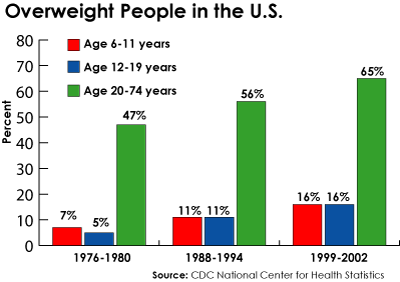
Government researchers found that in 2009 and 2010, about one in three adults and one in six kids and teens were obese. The rates represent no change from 2007 and 2008 figures, and only a slight increase among specific demographics over rates from the late 1990s and early 2000s.
"I'm not very surprised, but I think this is a kind of encouraging finding, given all the efforts we have been making," said Dr. Youfa Wang, head of the Johns Hopkins Global Center for Childhood Obesity in Baltimore, who was not involved in the new study.
"The general public for sure nowadays has become more aware of the health consequences of obesity, and industry has been heavily influenced by all the efforts," Wang told Reuters Health.
With rates of overweight and obesity in the U.S. increasing throughout the 1980s and 1990s, some researchers projected those trends would continue into the next century and that type 2 diabetes and heart disease risks would rise with them.
The most recent obesity data come from two nationally-representative studies of about 6,000 adults and 4,000 kids and teens who had their heights and weights measured in a mobile exam center in 2009 and 2010.
From that data, researchers calculated each person's body mass index, or BMI -- a ratio of weight to height. A BMI of 30 or over -- equal to a five-foot, six-inch adult weighing 186 pounds or a kid in the 95th percentile or higher on growth charts -- is considered obese.
Cynthia Ogden from the Centers for Disease Control and Prevention and her colleagues found that between 35 and 36 percent of both men and women were obese. While obesity rates in men were similar across races, that wasn't the case in women: 32 percent of white women were obese, compared to almost 59 percent of black women.
Compared to data from 1999 to 2000, the numbers represented a less than one percent annual increase in the rate of obesity in men overall, and no net increase in women. The exceptions were black and Mexican American women, who also had slightly higher obesity rates in 2009 and 2010 than a decade earlier.
Ogden said that the long-term results suggest rates of obesity in men have slowly caught up to rates in women.
But, she added, there was no change in obesity rates in any demographic compared to the most recent prior data, from 2007 to 2008.
Seventeen percent of kids and teens were obese, a rate that varied from 14 percent in white kids to almost a quarter of black kids. Overall rates were similar to those reported in 1999 and 2000 for girls, with a slight uptick in obesity among teen boys since then, Ogden and her colleagues reported in the Journal of the American Medical Association.
"I think that you can be fairly comfortable in saying that even if there is an increase, it's small relative to the increases in the 1980s and 1990s," Ogden said.
She told Reuters Health that there's also evidence that obesity rates are leveling off in some countries in Europe and elsewhere in the world.
RATES 'STILL QUITE HIGH'
Amika Singh, who has studied childhood obesity at VU University Medical Center in Amsterdam, said it's too early to draw conclusions on a more global scale.
"The basic thing is that, even if things are leveling off, these are still quite high numbers," Singh, who was not involved in the new research, told Reuters Health.
Ogden said it's difficult to point to one reason why the rate of obesity in the U.S. has seemed to stabilize, while some projections figured it would continue to rise.
"It was hard to know exactly why (the increase) was happening in the first place, because obesity is very complex and there are so many factors that contribute to it," she said.
Wang pointed toward efforts made by First Lady Michelle Obama to combat childhood obesity, as well as more funding going to research on obesity and how to prevent it.
"The impact is dramatic," he said. "I think this obesity data shows that a combination of many efforts can make some difference."
SOURCE: bit.ly/hwxtTL Journal of the American Medical Association, online January 17, 2012.

The Obama government has done nothing to promote companies or fund companies working in new innovations in obesity. The govt should fund these projects.